 UK
 EU
 AU
 UAE



Blog
How Long Does Roasted Coffee Stay Fresh? Shelf Life by Packaging Type
// Guide · Freshness & Materials
Coffee shelf life depends on far more than the date printed on the bag. Roasted coffee doesn’t spoil like fresh food: it goes stale, losing aroma and flavour as it reacts with oxygen and moisture. The packaging you choose can have a major effect on how quickly that happens.
This guide explains what freshness really means, what the research says about how long roasted coffee stays fresh, and the typical coffee shelf life in foil, recyclable, compostable and paper bags, both before and after opening. The figures come from our materials guide and published studies, so you can set a realistic best-before date.
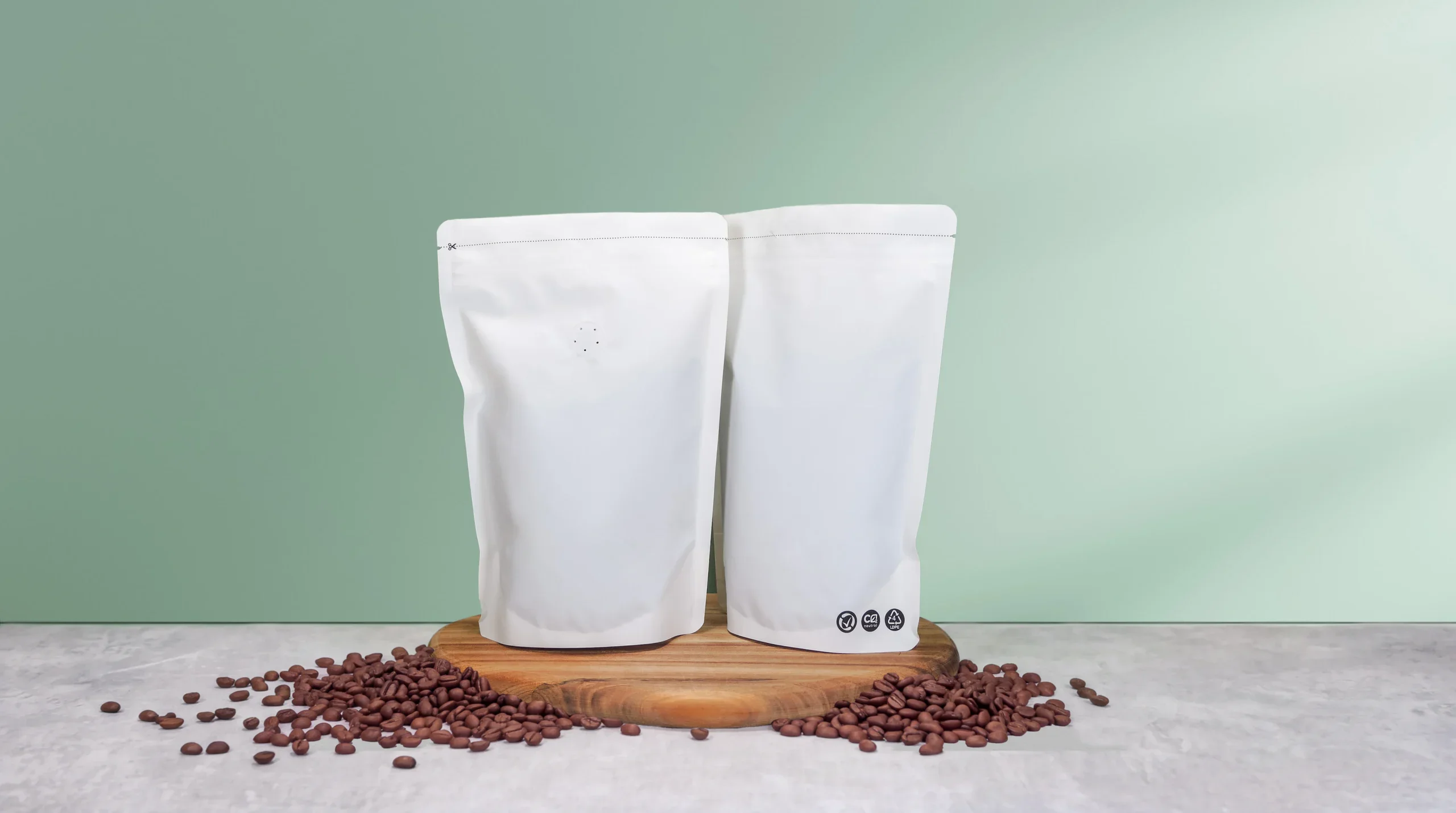
// What “fresh” means
Coffee shelf life: stale is not the same as unsafe
Stale coffee isn’t a safety problem. It simply tastes flat, dull or papery, so coffee shelf life is usually judged by quality and flavour, rather than food safety. In food science, shelf life is often defined as the point where most tasters would reject the product.[1]
Roasted coffee loses freshness in two main ways:
- Aroma loss: volatile aroma compounds escape from the bean over time.
- Oxidation: oxygen reacts with oils and flavour compounds, creating flat, stale or rancid notes.
Moisture and heat speed both of these up, and so does grinding, because it exposes far more surface area. The job of coffee packaging is to slow all of this down.
Rule of thumb
A bag’s coffee shelf life describes how long the packaging can protect the coffee. It isn’t the same as how long the coffee tastes its best. Peak flavour comes earlier.
// The research
What the research says about coffee shelf life
Coffee staling, and with it coffee shelf life, has been studied for decades. These are the findings that matter most for packaging.
~20×
shelf-life increase reported at 0.5% oxygen[1]
5×
slower staling when vacuum packed[1]
Month 1
when freshness loss is fastest[1]
Near 0%
oxygen in unopened nitrogen-flushed valve bags[2]
Oxygen is the biggest threat. A literature review by the Specialty Coffee Association summarises research showing oxygen as the main factor controlling coffee shelf life. It cites work finding that cutting oxygen to 0.5% could extend coffee shelf life roughly twenty-fold, and that each 1% rise in oxygen increased the rate of degradation by around 10%.[1]
Flushing and vacuum packing improve coffee shelf life. The same review reports that nitrogen-flushed coffee had a six-month sensory shelf life versus three months for unflushed bags, and that vacuum-packed coffee staled about five times more slowly than coffee packed in air.[1]
Freshness loss is fastest early on. Research cited in the review found the greatest rate of freshness loss occurs during the first month after roasting.[1] That’s why many roasters suggest enjoying whole beans within a few weeks of the roast date, even when the bag can protect them for much longer.
Unopened high-barrier valve bags can maintain very low oxygen levels. In a 2022 study in Food Packaging and Shelf Life, roasted Arabica was packed under nitrogen in 1 kg foil-laminate bags with one-way valves. Oxygen stayed close to zero in the unopened packs while carbon dioxide rose from about 70% to about 77% over nine weeks. A good valve bag lets CO2 out without letting air back in.[2]
Mono-material vs multi-material bags. A 2026 study in Processes stored roasted Arabica for 28 days at 25, 40 and 50 °C in a polyethylene (PE) monomaterial pack and a PET/aluminium/PE multimaterial pack. The multimaterial pack gave better oxidative stability: based on peroxide value, the estimated shelf life at 25 °C was 179 days for the monomaterial pack versus around 450 days for the multimaterial pack. On a second measure (p-anisidine value) the gap was much smaller, at 63 versus 79 days. The authors still call monomaterial PE promising because it uses less material and is recyclable.[3]
Two cautions. Accelerated tests estimate shelf life by storing coffee warm, using kinetic models, so they’re guides rather than real-time results.[4] And the PE pack in that study was described as polyethylene only, so it may not match a PE bag with an EVOH barrier layer like our recyclable PE bags.
// Shelf life by material
Coffee shelf life by packaging type
These are the typical and maximum ranges from our materials guide. They describe the packaging for unopened coffee. They are useful as a starting point, but they are not a guarantee of coffee shelf life. Real-world results depend on the coffee, filling process, residual oxygen, storage conditions and packaging construction.
12–18 months (up to 22)
9–12 months (up to 18)
6–9 months (up to 18)
6–9 months (up to 18)
Up to about 6 months
3–6 months
3–6 months
| Material | Barrier | End of life | Best for |
|---|---|---|---|
| Foil laminate | Highest | Not recyclable | Wholesale, export, slow sellers |
| Ceramic barrier | Very high, no metal layer | Not recyclable | Long life without foil |
| Recyclable PE / PCR | High (EVOH layer; weaker in humidity) | PE film recycling where collected | Freshness plus a recycling route |
| Compostable NKME | Strong against gases and aromas | Home and industrial compostable (valve industrial only) | Fast-turnover, eco-led brands |
| Compostable PLA | Good | Industrial compostable | Printed compostable bags |
| Paper Stream | Moderate | Kerbside paper (remove valve first) | Local, quick sales |
Want the full detail on each construction? See our recyclable vs compostable comparison.
// Which group fits you
Three ways to match your bag to your coffee shelf life
The right bag depends on how quickly you sell and how far your coffee travels. Every option below can carry a valve, and each one changes coffee shelf life in a different way.
Longest life
Foil and ceramic barrier
For wholesale, export, subscriptions and slower-selling lines. Strongest protection, but not recyclable.
The balance
Recyclable PE and PCR
Around 6–9 months typical with a recycling route where PE film is collected. Watch storage in humid conditions.
Fast turnover
Compostable and paper
Roughly 3–6 months of protection. A great fit when coffee sells quickly and the end-of-life route is appropriate for the brand and local infrastructure.
// After opening
How long does coffee stay fresh once the bag is open?
Once a bag is open, freshness falls faster. This stage of coffee shelf life is called secondary shelf life.
In a 2006 study, ground dark-roasted Arabica was opened briefly each day to mimic home use and stored at 30 °C. Estimated coffee shelf life was about 20 days in dry conditions, falling to about 13 days at higher moisture levels.[5] That’s ground coffee at a warm temperature, so treat it as a worst case rather than a rule for whole beans in a cool kitchen.
How the bag is closed matters too. The 2022 study compared four ways of storing opened whole beans:[2]
- Integrated screw cap: slowed staling the most.
- Clip: second best.
- Tape and metal canister: staled fastest, because each opening replaced much of the headspace with fresh air.
The practical lesson: a resealable zip or closure helps customers keep coffee fresh. Tell them to keep the bag sealed as tightly as possible after every use. The authors measured aroma chemistry rather than taste, so sensory studies would be needed to say exactly when coffee becomes unacceptable.
// What extends freshness
Five packaging features that extend coffee shelf life
- A proper barrier layer. Foil, ceramic, EVOH-containing barrier structures or high-barrier cellulose film can slow oxygen and moisture. Check the material before the price.
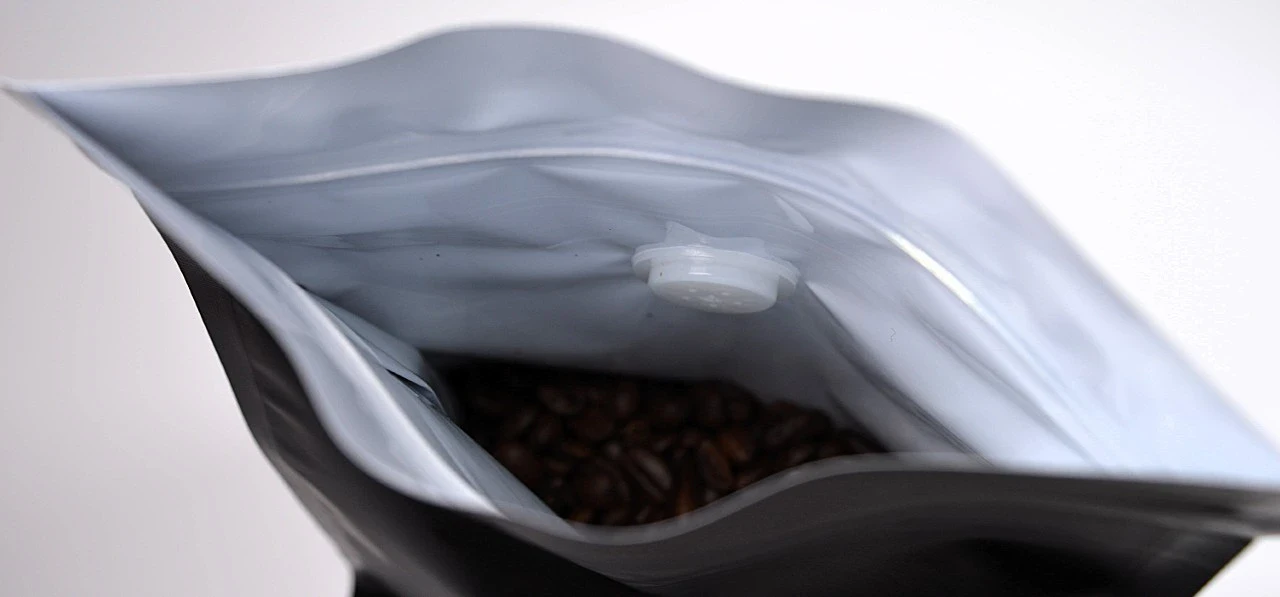
- A one-way valve. Fresh roasted coffee releases CO2. A valve lets it out without letting air in. Read why coffee bags have valves.
- Nitrogen flushing or low residual oxygen. Reducing the oxygen sealed in with the beans has a big effect.[1]
- A good seal. A weak heat seal or poorly fitted valve lets oxygen in. Check seals on every batch.
- A resealable closure. Zips and tin ties help customers keep coffee fresh after opening.
Don’t skip it
A valve alone isn’t enough. Without a barrier film and a good seal, oxygen still gets in. The valve, barrier film and good seal need to work together.
// Choosing
How to choose packaging for your coffee shelf life needs
- How fast do you sell? If coffee sells quickly, compostable or Paper Stream bags can be a strong fit. If it needs to sit for several months, consider a higher-barrier structure.
- How far does it travel? Wholesale, export and subscription boxes add days or weeks, so pick a longer-life material.
- What are your sustainability goals? Recyclable PE can offer a long shelf life with a recycling route where suitable collection exists. Compostable packaging may suit brands with an appropriate composting route and a shorter intended shelf life.
- Test it yourself. Pack one roast in two or three bag types, store them together and cup them at 2, 4, 8 and 12 weeks. It’s the best way to set a realistic best-before date.
Test before you commit
Not sure which suits your roast? Request free samples and run your own shelf-life test.
// Tips for customers
How to store roasted coffee at home
These tips help customers get the most from your coffee shelf life, and they’re worth printing on a card, a label or your website:
- Keep the bag sealed as tightly as possible after each use.
- Store it somewhere cool, dark and dry, away from the cooker, kettle and sunny windows.
- Buy whole beans and grind just before brewing, because ground coffee goes stale faster.[1]
- Don’t decant into a big container with lots of air. Keep it in the original valve bag.
- Use the roast date as your guide, not only the best-before date.
// FAQ
Coffee shelf life: frequently asked questions
How long does roasted coffee stay fresh after roasting?
There’s no single figure. Freshness loss is fastest during the first month,[1] and many roasters suggest drinking whole beans within roughly four to six weeks of roasting. A good barrier bag can slow staling considerably, but how long coffee stays acceptable depends on the standard you set and on how the bag is filled and stored.
How long does coffee last after opening?
Plan on a few weeks. In one study, opened ground coffee at 30 °C stayed acceptable for about 13 to 20 days.[5] A cooler, well-sealed bag of whole beans should do better.
Does ground coffee go stale faster than whole beans?
Yes. Grinding exposes far more surface area to oxygen, so ground coffee generally loses freshness faster than whole beans.[1]
Do one-way valves keep coffee fresh?
They help. A valve releases CO2 while stopping air getting in. Paired with a barrier film and a good seal, it protects the coffee. Without a barrier film, a valve alone isn’t enough.
Do compostable bags keep coffee as fresh as foil?
Not for as long. Our materials guide gives compostable and Paper Stream bags typical ranges of around 3–6 months, compared with 12–18 months for high-barrier foil laminates. These are packaging guidelines, not guarantees of actual coffee shelf life. They suit fast-turnover coffee well.
Is stale coffee dangerous?
Not simply because it has gone stale. Stale coffee has lost flavour, but that alone isn’t usually a safety concern. However, coffee stored damp can develop mould and should be thrown away.
What best-before date should I put on my coffee?
Use your own shelf-life testing to determine the best-before date for your coffee. Packaging material, residual oxygen, filling conditions, roast profile and storage conditions all affect the result. Our material ranges can be used as a general reference, but they are not a substitute for product-specific testing. Our team can help you choose.
// References
- Sage, E. (2012). What is the Shelf Life of Roasted Coffee? A Literature Review on Coffee Staling. Specialty Coffee Association. sca.coffee
- Smrke, S., Adam, J., Mühlemann, S., Lantz, I. & Yeretzian, C. (2022). Effects of different coffee storage methods on coffee freshness after opening of packages. Food Packaging and Shelf Life, 33, 100893. digitalcollection.zhaw.ch
- Cabral, D. V. et al. (2026). Effect of Monomaterial and Multimaterial Packaging on the Stability of Bioactive Compounds and Lipid Oxidation in Roasted Arabica Coffee. Processes, 14(11), 1740. mdpi.com
- Cueva Ríos, M. A. et al. (2023). Estimation of coffee shelf life under accelerated storage conditions using mathematical models: a systematic review. Czech Journal of Food Sciences, 41(2), 92-102. cjfs.agriculturejournals.cz
- Anese, M., Manzocco, L. & Nicoli, M. C. (2006). Modeling the secondary shelf life of ground roasted coffee. Journal of Agricultural and Food Chemistry, 54(15), 5571-5576. pages.uoregon.edu
Not sure which bag will keep your coffee fresh?
Tell us how you roast, sell and ship, and we’ll help you match a material to your coffee shelf life needs. You can also test our bags with free samples before you commit.
Get a quote Compare materials Request free samples